
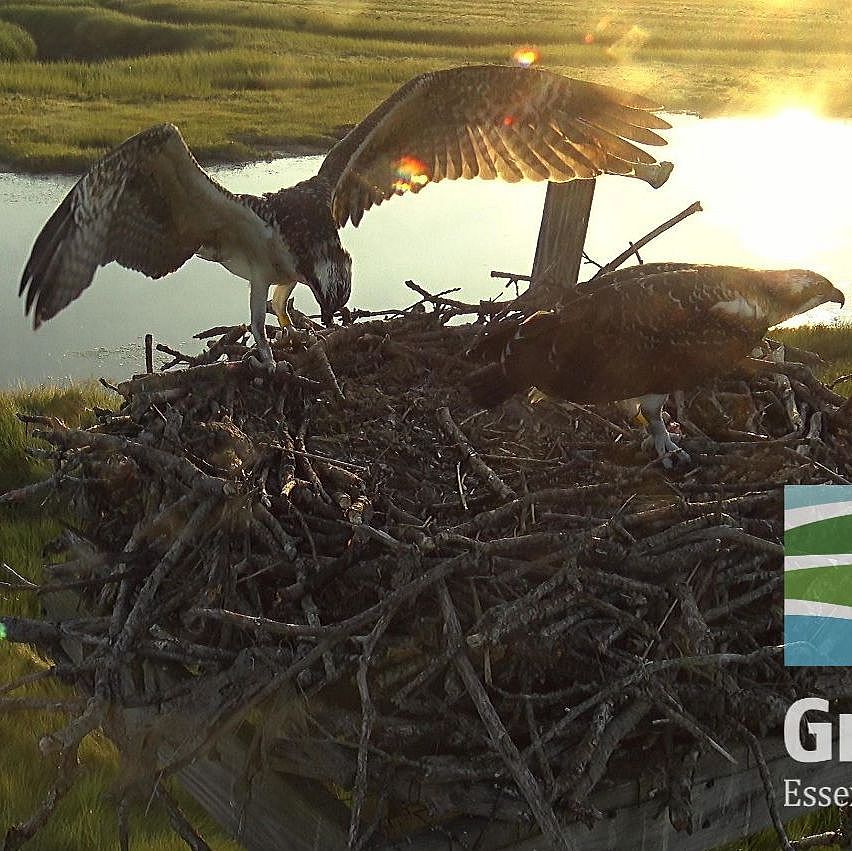
Good morning and what a gorgeous late July morning it is! I've been checking in on Sunny and Stormy quite a bit of late because I am recovering from hip replacement surgery, and these two youngsters are developing beautifully. They are now approximately 53 and 55 days old and as the photo shows from earlier this morning and, you are seeing if you are watching, there is a lot of wing flapping going on as well as jumping up to and down from the side perch on the nest. So these chicks are very very close to making their first flight off the nest and fledging. Exciting.
What happens then? Well, at first they won't go far and they will keep returning to the nest, because that will remain their gravy train for food until they gain the skills to hunt fish on their own. Usually that translates to them remaining on the nest for 3-4 weeks post-fledging, although as time passes, they may roost off the nest at night - probably in a nearby tree. As we have discussed before, Annie usually starts spending a lot less time on the nest post-fledging, which I assumed meant she left not to return. But last year, she made a few reappearances at the nest which was interesting, suggesting she hadn't strayed too far away but was leaving all parenting duties to Squam, who will continue to bring fish in for Sunny and Stormy until they become fully independent.
Sunny and Stormy need to gain significant strength and skills in order to make the long migratory journey south. That starts right away post-fledging, as they building up their flight muscles and improve their flying skills. At some point, with Annie and Squam long gone, a deeply embedded instinct will compel them to start their first migration.
We will keep the webcam operating through September, although most years be Sep 1 the nest has no more occupants except the passersby that use it as a resting perch. We've seen other Osprey, Bald Eagles, Great-Blue Herons and a variety of other birds use the nest as a perch, which they will do of course regardless of the webcam operating.
Around the region, the incredible hard work of Greenbelt's many volunteer Osprey nest monitors has produced over 1900 online reports (and counting), and provided invaluable data. I need to sort through the data more thoroughly, but without question there have been 100+ breeding pairs of Osprey in our region in 2026 - a significant jump from the 92 pairs in 2025. With that growth also came more nest failures - mostly due to predation from Great-Horned Owls, one very low lying nest on the salt marsh that was washed away in a high tide, plus other unknown causes. We were able to band some chicks, and did find a few nests with dead or underdeveloped chicks - a suggestion that food availability remains a critical factor for chick survival. Reports from other regions in MA and other states suggest scarcity of forage fish continues to be a real limiting factor for productivity. For now, I do not think it is a serious issue here north of Boston, but we are watching it closely. I think the overall productivity in our region will be strong but I won't know until final data on fledglings comes in from our volunteers.
Let me know at osprey@ecga.org if you see Sunny or Stormy fly off before I do. And as always feel free to send me any questions.